
WhatsApp Broadcast vs WhatsApp Groups: Differences and When to Use Each
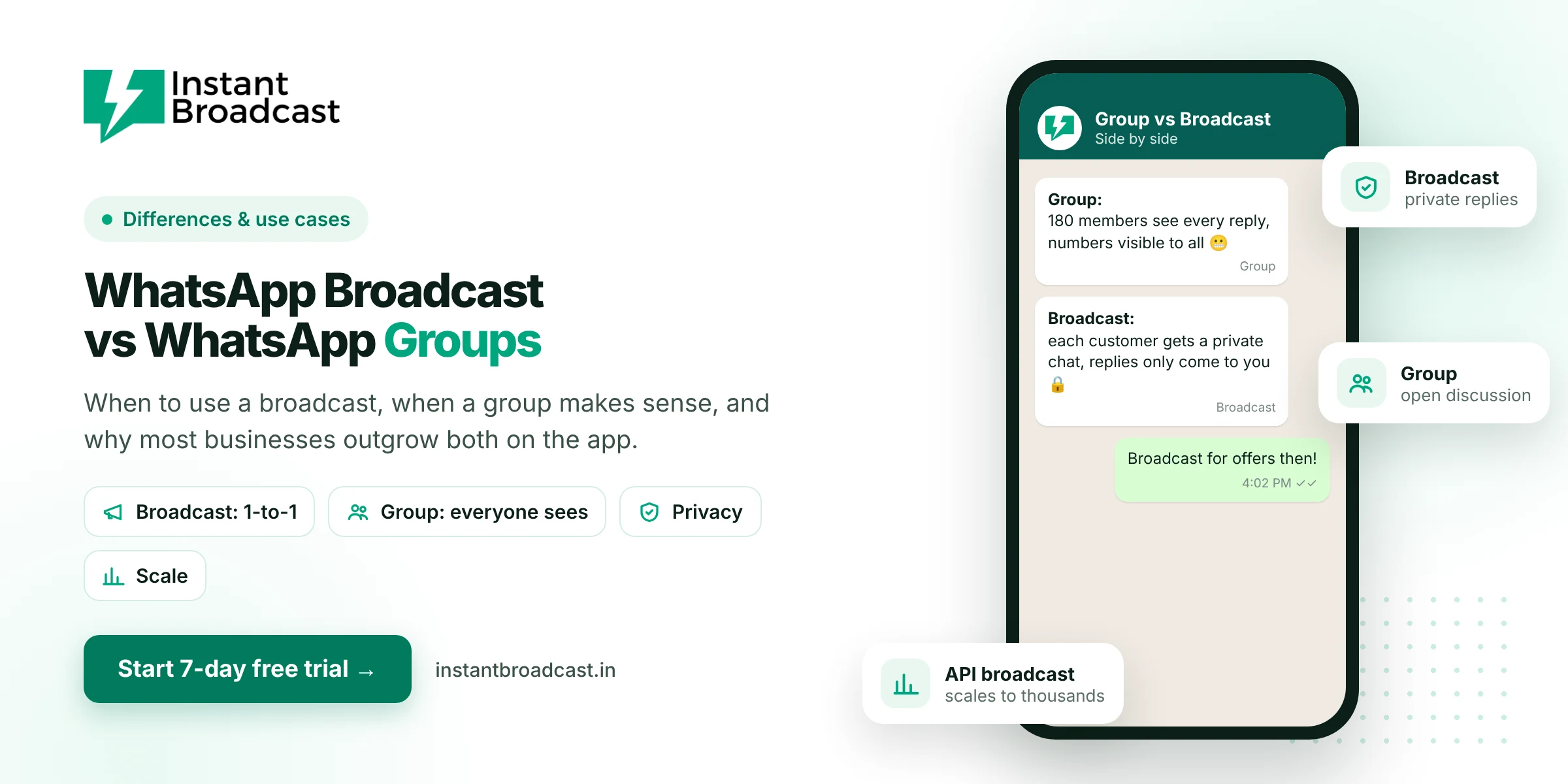
A WhatsApp broadcast sends your message to many people as separate private chats, so each person replies only to you. A WhatsApp group puts everyone in one shared conversation where all members see every message, and usually each other's numbers. For business offers and updates, broadcasts are almost always the better choice. Groups suit communities where members genuinely need to talk to each other.
Plenty of Indian businesses still run their customer communication through a "Customers 2024" group with 300 members. It works until it doesn't: someone posts a complaint for everyone to see, a competitor joins and copies your price list, or half the members mute the group. Here's how to choose properly.
WhatsApp Broadcast vs WhatsApp Groups: The Core Difference
| Broadcast | Group | |
|---|---|---|
| How it looks to the customer | A normal private chat with your business | A shared chat with many people |
| Replies | Only you see them | Everyone sees them |
| Members see each other's numbers | No | Usually yes |
| Who can post | Only you | Everyone, unless you restrict it to admins |
| Feels like | Personal message | Community noticeboard |
| Risk | Low, if customers opted in | Complaints, spam and competitors in public |
When a broadcast is the right choice
- Offers and new launches, where you want each customer to reply privately with their size, quantity or question.
- Order, payment and appointment updates, which are personal by nature.
- Price lists to dealers, where dealers shouldn't see each other or each other's rates.
- Anything where privacy matters, such as patients, students' parents or high-value clients.
When a group makes sense
- Batch or class groups, where students ask doubts that help everyone.
- Resident or society communities where members discuss among themselves.
- Small internal teams, such as your sales team or a distributor network that needs to coordinate.
- Event attendees who benefit from talking to each other for a short time.
If you do run a business group, set it so only admins can send messages, and write clear rules. Otherwise it quickly turns into forwards and good-morning messages.
The limits of broadcasts on the WhatsApp Business app
Broadcast lists on the free app come with real restrictions:
- Each broadcast list can hold only a limited number of contacts (256 per list).
- A customer receives your broadcast only if they've saved your number. Many never do, so a large share of your list silently misses every message.
- There are no proper reports on who received or read each broadcast.
- All replies land on one phone.
Broadcasts on the WhatsApp Business API
With the official WhatsApp Business API, broadcasts work differently. You send an approved template to an opted-in segment of any size your messaging limit allows, and customers receive it whether or not they saved your number. You get delivery and read reports, and replies go into a shared team inbox. That's what tools like WhatsApp broadcast software are built for.
| App broadcast list | API broadcast | |
|---|---|---|
| Recipients per send | Up to 256 per list | Your daily messaging limit, which grows over time |
| Saved-number rule | Required | Not required (opt-in is) |
| Images, PDFs, buttons | Basic | Templates with media and buttons |
| Reports | Minimal | Sent, delivered, read, failed |
| Cost | Free | Per message (₹1.12 marketing on our India rate card) |
What about WhatsApp Channels and Communities?
Channels are one-way: you post updates, followers read them and can react, but they can't reply privately in the channel. Followers don't see each other's numbers. A channel is good for brand updates, but not for selling, because you can't have a private conversation there. Communities group several related groups under one umbrella, which is useful for schools, housing societies and large organisations.
A simple decision guide
- Do you want private replies from customers? → Broadcast.
- Do members need to talk to each other? → Group (admin-only posting if it's large).
- Do you only want to publish news to followers? → Channel.
- Is your list bigger than a few hundred, or do you need reports and team replies? → API broadcast.
One rule for all three
Only add people who want to hear from you. Adding customers to groups without asking, or broadcasting to numbers you bought, gets you blocked and reported. On the API, that lowers your quality rating and your messaging limit.
Official references: Meta’s WhatsApp Business Platform documentation and the WhatsApp Business Messaging Policy.
Frequently asked questions
What is the difference between WhatsApp broadcast and group?
A broadcast sends a message to many people as separate private chats, so replies come only to you. A group is one shared chat where all members see every message and usually each other's numbers.
Which is better for business, broadcast or group?
For offers, updates and anything personal, broadcasts are better because they're private and look like a one-to-one message. Groups suit communities where members need to talk to each other.
How many contacts can be in a WhatsApp broadcast list?
On the WhatsApp Business app, each broadcast list can hold up to 256 contacts. With the WhatsApp Business API, you can broadcast to larger opted-in segments within your daily messaging limit.
Why don't some people receive my broadcast?
On the WhatsApp app, people only receive broadcasts if they've saved your number. The API removes this restriction for opted-in customers.
Can group members see my customers' numbers?
In a regular group, members can usually see each other's phone numbers, which is a privacy risk for business use.
What is a WhatsApp Channel?
A one-way broadcast tool where you post updates to followers. Followers can react but can't reply privately in the channel, and their numbers stay hidden.
Is a WhatsApp API broadcast free?
No. Broadcast templates are charged per message. Marketing messages cost ₹1.12 each on the Instant Broadcast rate card for India.
Can I send broadcasts without customers saving my number?
Yes, through the WhatsApp Business API, as long as customers have opted in to receive your messages.